TPBot Robot Car: A Look at This Beginner Robotics Platform
Whenever I evaluate a robotics kit designed for beginners, I always look for two things: how easy it is to start and how far it can take the learner. A good robotics kit should allow someone with no prior experience to begin quickly, while still offering enough capability to explore deeper concepts in programming, sensors, and automation.
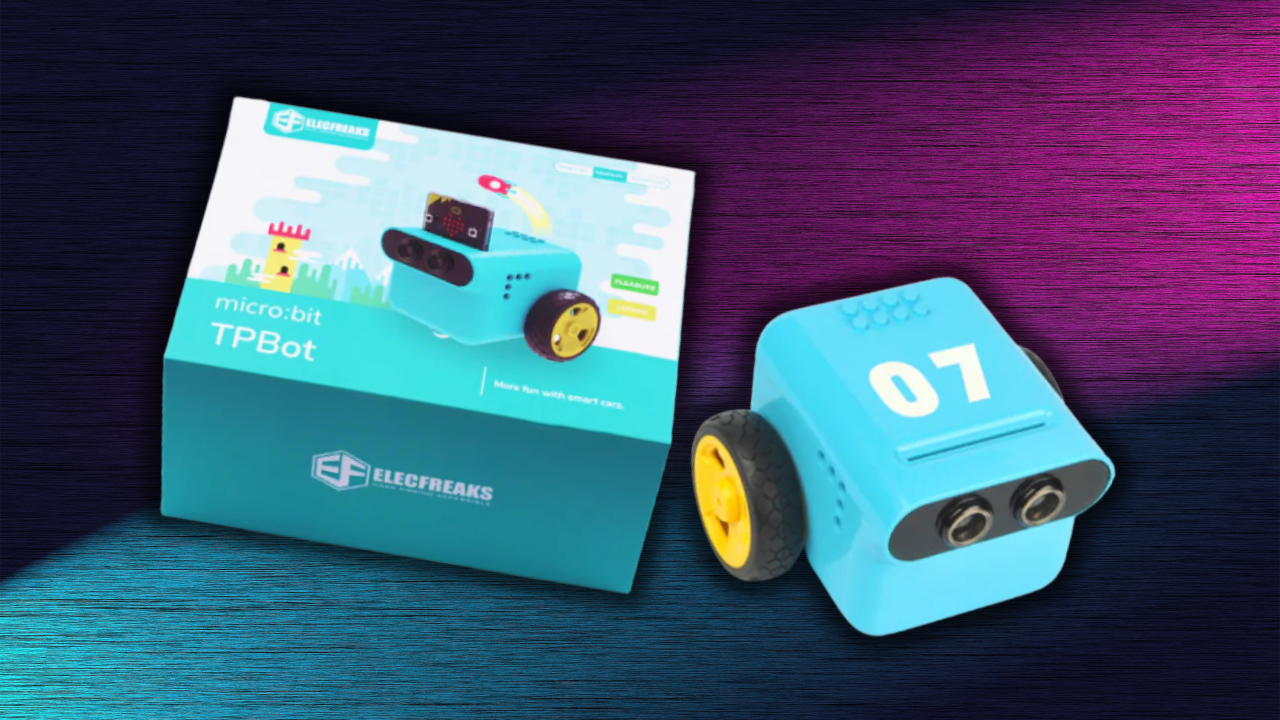
The ELECFREAKS TPBot micro:bit robot car is designed with this balance in mind. It is compact, simple to deploy, and built specifically for robotics education using the BBC micro:bit platform. In this article, I will take a closer technical look at the TPBot, explore its hardware architecture, and explain why it works well as a beginner robotics learning platform.
Why the TPBot is a Great Robot for Beginners
One of the strengths of the TPBot is that it reduces the hardware complexity typically associated with robotics kits. Instead of requiring users to assemble multiple circuit modules and drivers, the TPBot integrates its core electronics into a compact robot platform.
This allows beginners to focus on the two most important robotics concepts: sensing and control.
The robot uses the BBC micro:bit as its main controller, which provides both computational capability and a beginner-friendly programming environment. Using the Microsoft MakeCode platform, users can program the robot through a graphical block interface or transition to text-based programming using Python.
For beginners entering the world of robotics, this combination is extremely valuable. It allows them to learn how software interacts with hardware, without the complexity of configuring low-level electronics.
Let’s Unbox TPBot!
The TPBot kit provides most of the components required to build a functional robot car. The only component that must typically be purchased separately is the BBC micro:bit board, which serves as the robot’s control unit.
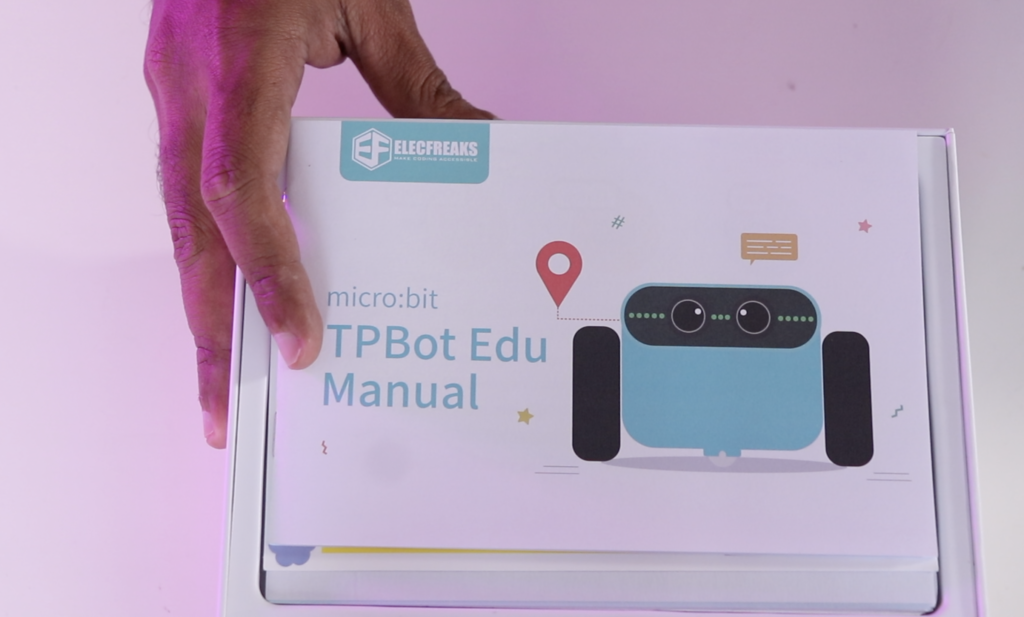
The kit includes:
- The TPBot robot chassis
- Dual DC drive motors (130 type motors)
- Ultrasonic distance sensor module (HC-SR04)
- Line-following sensor module
- RGB programmable LED headlights
- Battery holder supporting 4 AAA batteries
- Expansion ports including P1, P2, P8, P12 and I²C
- LEGO-compatible structural mounting points
Once the micro:bit is inserted into the TPBot expansion board, it acts as the central processing unit for the robot, handling sensor input, motor control, and program execution.
Get Your TPBot
TPBot Design
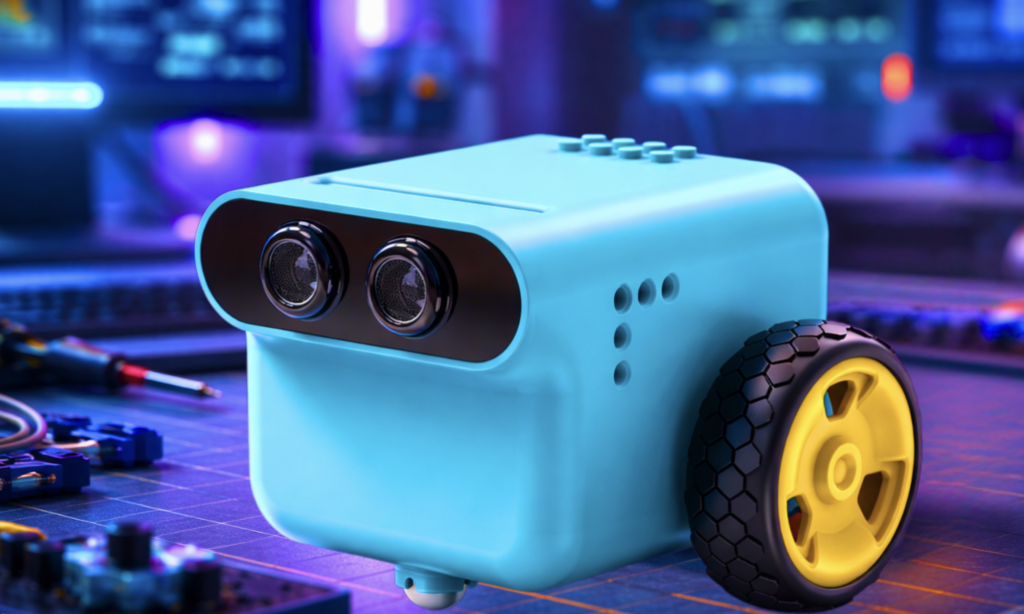
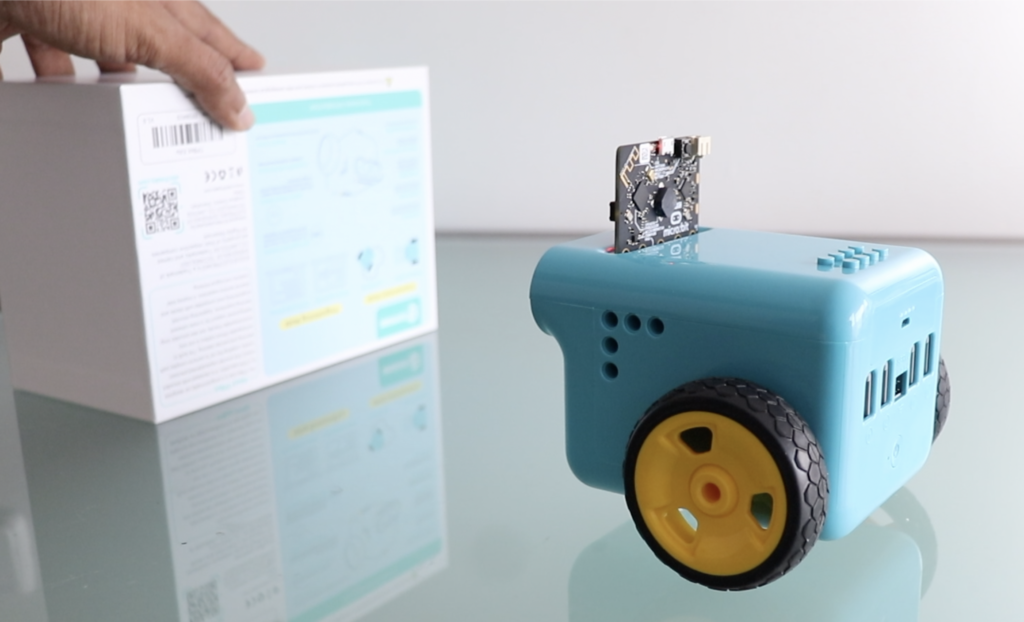
From an engineering perspective, the TPBot follows a simple differential-drive robot design. This is one of the most common drive mechanisms used in educational robotics.
The robot is powered by two rear DC motors connected to independent wheels. By controlling the speed of each motor separately, the robot can move forward, reverse, or rotate. A front omni wheel provides passive support and allows smooth turning without additional steering mechanisms. This design has several advantages:
- Fewer moving parts
- Easier motor control
- Good maneuverability
- Reliable stability for beginners
Another thoughtful design feature is the LEGO-compatible mounting surface. This allows users to extend the robot by adding mechanical structures such as arms, sensor mounts, or decorative components.
This compatibility encourages creativity and makes the TPBot useful not only as a programming platform but also as a mechanical experimentation tool.
Body : The TPBot features a compact and durable structure suitable for classroom environments. The approximate dimensions of the robot are 128 × 113 × 90 mm, which makes it small enough for desktop experiments while still providing enough space for sensors and attachments.
Its lightweight chassis ensures efficient motor performance and good battery life during continuous operation.
Motors : The robot is powered by two 130-type DC motors, which are commonly used in educational robotics platforms. These motors drive the rear wheels, each with a diameter of approximately 62 mm.
This wheel size provides a good balance between torque and speed, allowing the robot to move smoothly across typical indoor surfaces.
A 14 mm omni wheel located at the front provides stability and allows the robot to pivot without friction.
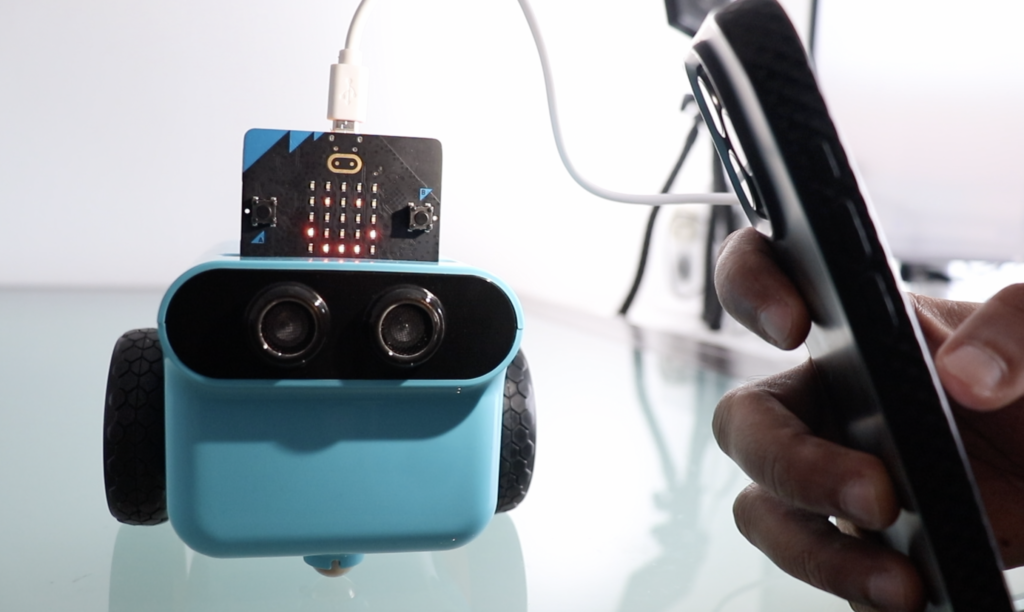
Sensors : The TPBot includes two primary sensors that introduce fundamental robotics concepts.
The ultrasonic sensor measures distance by emitting sound waves and calculating the time it takes for the echo to return. It can detect obstacles up to approximately 4 meters away, making it ideal for obstacle avoidance experiments.
The line-following sensor detects contrast between dark and light surfaces. This allows the robot to follow black lines on a white background, which is commonly used in robotics competitions and autonomous navigation experiments.
RGB Headlights : The robot includes three programmable RGB LEDs that can be controlled through code. These LEDs allow the robot to display different colors or patterns depending on its current state.
For example, the robot can display green while moving forward, red when an obstacle is detected, or blue when idle. While simple, this feature introduces beginners to visual feedback systems in robotics.
Battery : The TPBot is powered by four AAA batteries, providing an operating voltage between 4.5V and 6V. Under typical usage conditions, the robot can operate for approximately 1.5 hours of continuous activity.
This power system keeps the design simple and avoids the need for specialized rechargeable batteries.
TPBot Robot Car – Key Functional Features
- Beginner-Friendly Design : The TPBot platform is designed to make robotics accessible for beginners. Using the MakeCode block programming environment, users can build programs by connecting logical blocks together.
This approach removes the complexity of writing syntax-based code and allows beginners to focus on the logic behind robotic behaviors. - Built-in Ultrasonic Sensor : The integrated ultrasonic sensor allows the robot to detect obstacles in front of it. Programs can use this data to stop the robot, change direction, or trigger other actions.
This introduces learners to the concept of sensor-based decision making, which is essential in robotics. - Line Tracking Capability : Using the line sensor, the TPBot can follow predefined paths on the ground. This functionality demonstrates how robots interpret environmental data and adjust their motion accordingly.
Line following is often one of the first steps in understanding autonomous navigation. - Programmable RGB Headlights : The RGB LEDs allow students to integrate visual indicators into their programs. This teaches how robots communicate status information through light signals.
- LEGO Compatibility : The robot chassis supports LEGO-style building bricks. This allows students to design additional mechanical structures, making the platform highly customizable.
- Bluetooth Remote Control: When paired with another micro:bit device, the TPBot can be controlled via Bluetooth. This introduces students to wireless communication and remote robotics control systems.
Programming the TPBot
Programming the TPBot is straightforward thanks to the micro:bit ecosystem. After inserting the micro:bit into the robot, users can open Microsoft MakeCode and create programs using a drag-and-drop interface.
Even a simple program can demonstrate key robotics concepts. For example, a program might instruct the robot to move forward for two seconds, stop, and then turn. Within a few minutes,users can see their code directly controlling a physical machine.
Connection and Code Upload
Getting started with the TPBot requires only a few steps.
First, insert the micro:bit board into the expansion slot on the robot. This board acts as the main processor and executes the uploaded programs.
Next, connect the micro:bit to a computer using a USB cable. The micro:bit appears as a removable storage device. Using the Microsoft MakeCode website, create a program and click the Download button. The generated file can then be dragged directly onto the micro:bit drive. Once the file is transferred, the micro:bit automatically begins executing the program.
After installing the batteries and turning on the robot, the TPBot will immediately perform the programmed actions. From here, users can expand their experiments by integrating sensor logic, obstacle avoidance routines, line tracking algorithms, and LED effects.
Real Robotics Experiments Using the TPBot Car
The TPBot supports several practical robotics experiments. One common experiment is obstacle avoidance, where the robot continuously measures distance and adjusts its movement to avoid collisions.
Another popular activity is line following, where the robot autonomously navigates along a predefined path.
More advanced experiments include maintaining a fixed distance from objects, which introduces the concept of feedback control systems. These activities demonstrate how robots interpret sensor data and translate it into movement decisions.
A Great First Robot for Young Engineers
The TPBot platform simplifies the process of learning robotics by reducing the technical barriers that often discourage beginners. Students do not need deep knowledge of electronics to begin experimenting. Instead, they can focus on understanding how sensors collect data, how motors move the robot, and how programming logic coordinates everything. This hands-on approach transforms robotics from a theoretical subject into a practical learning experience.
Through experimentation, students learn how controllers send signals to motors, how sensor inputs affect decisions, and how software controls real-world devices. This combination of hardware interaction, logical thinking, and creative experimentation makes the TPBot an effective tool for STEM education.
Price
The ELECFREAKS TPBot is positioned as an affordable robotics learning platform.
The standard TPBot kit without the micro:bit board is typically priced around $79.90 USD. The TPBot Edu version, which includes the micro:bit board and additional educational materials, costs approximately $102.99 USD. Considering the integrated sensors, motors, and educational resources, the kit provides good value for students, hobbyists, and classrooms.
Summary
The ELECFREAKS TPBot micro:bit robot car demonstrates how robotics can be introduced in a structured yet accessible way. By combining a simple mechanical platform with sensors and an easy programming environment, it allows beginners to explore core robotics concepts without unnecessary complexity.
For students, educators, and hobbyists looking for a starting point in robotics, the TPBot offers a reliable and engaging platform to begin experimenting with programming, sensors, and autonomous behavior.